
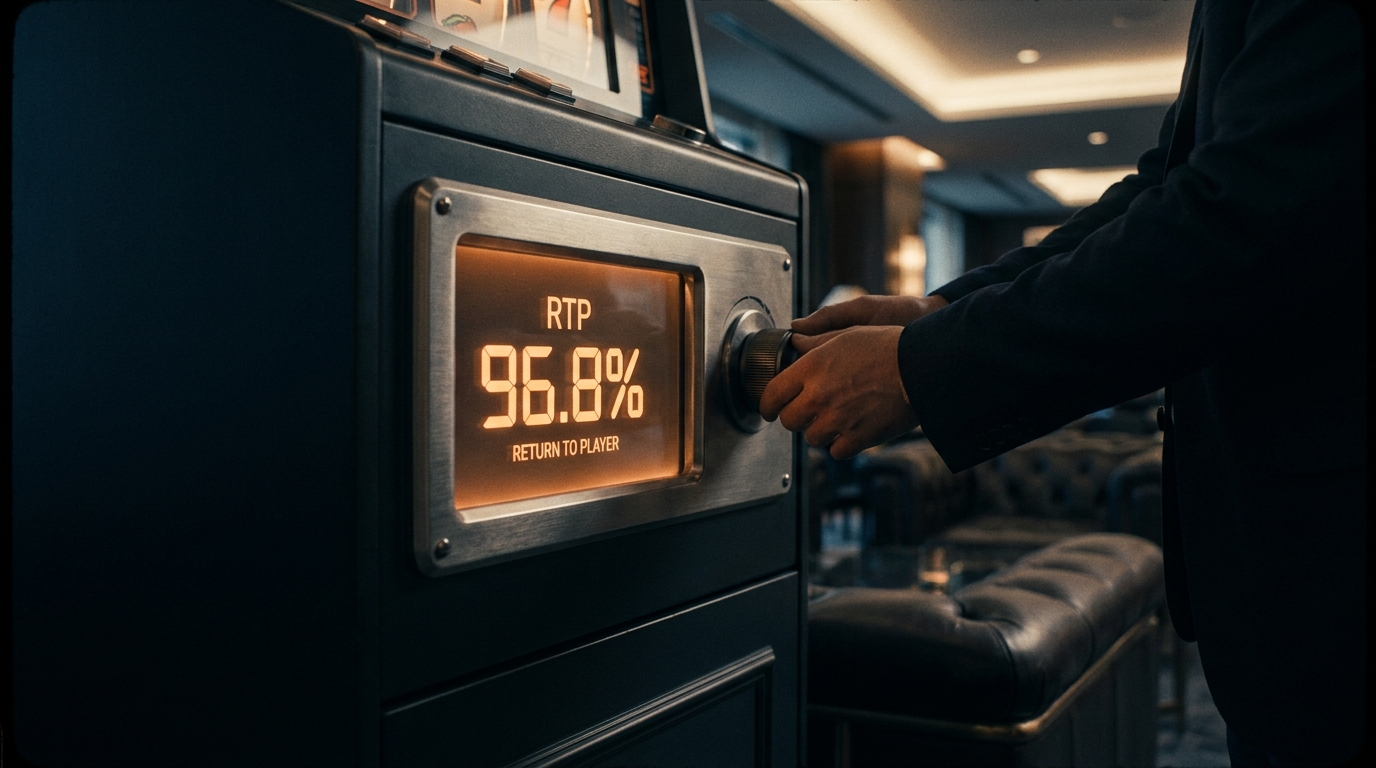
TL;DR: A good RTP for an online slot is 97% or higher. Anything above 98% is exceptional. The industry average sits around 96%, which means most players are quietly bleeding margin they don't need to. Choosing slots by RTP is one of the few decisions that genuinely changes your long-run results — and it costs nothing extra to do it right.
What Does RTP Actually Mean — and Why Should You Care?
RTP stands for Return to Player. It's the percentage of all wagered money a slot pays back over millions of spins, calculated and verified by independent testing labs like eCOGRA, iTech Labs, and GLI. A slot with 96% RTP returns £96 for every £100 wagered in the long run. The remaining 4% is the house edge.
That sounds small. It isn't.
Consider two players betting £5 a spin, 400 spins per session:
| Slot RTP | House Edge | Expected Loss Per Session |
|---|---|---|
| 92% | 8% | £160 |
| 96% | 4% | £80 |
| 97% | 3% | £60 |
| 98.1% | 1.9% | £38 |
Same stakes. Same session length. The player on the 98.1% slot loses £122 less than the one on the 92% slot — every single session. That's not a trick. That's published math.
The data is public. Almost nobody acts on it.
The RTP Benchmark Bands: Average, Good, and Great
Not all slots are created equal. Here's how to read the landscape quickly:
Below Average — Avoid
- Below 94% RTP — common on land-based machines and some mobile-first titles. The house edge here is brutal. These slots fund the flashy lobbies.
- 94–95.9% — still below the industry norm. Playable, but you're paying a premium for no reason.
Average — The Default You're Probably Stuck On
- 96–96.9% — this is where the bulk of the market sits. Studios like Pragmatic Play and NetEnt publish many titles in this band. It's fine. It's not an edge.
Good — Where Serious Players Start Looking
- 97–97.9% — a meaningful step up. At this level you're cutting expected session losses by 25% compared to a 96% slot. Titles like Blood Suckers (NetEnt, 98%) and Ugga Bugga (Playtech, 99.07%) live in this territory or above.
Great — The Tier Advantage Players Target
- 98%+ — these slots exist, they're real, and most players walk straight past them because they don't check. An RTP above 98% is where the house edge shrinks to the point that a well-timed bonus or a positive variance run can flip a session into profit territory.
| RTP Band | House Edge | Verdict |
|---|---|---|
| Below 94% | 6%+ | Avoid |
| 94–95.9% | 4–6% | Below average |
| 96–96.9% | 3–4% | Industry average |
| 97–97.9% | 2–3% | Good |
| 98%+ | Under 2% | Great — target these |
One Number Isn't the Whole Story: Variance and Live RTP
Published RTP is a theoretical long-run figure — it's calculated over hundreds of millions of spins. In any single session, variance (volatility) is the force that determines what actually happens to your bankroll.
High-variance slots swing hard. A 97% RTP title with extreme volatility can drain a 100-spin bankroll before the math has time to breathe. Low-variance slots at 96.5% might produce a steadier, more predictable session. Matching RTP to variance to your bankroll is the actual skill here.
But there's a second layer most players miss entirely: live RTP.
Slots don't pay at exactly their published rate every day. Real-world payout data fluctuates — games run hot for a period (paying above their baseline) and cold for others. Tracking which slots are currently paying above their published RTP, across thousands of titles simultaneously, is impossible to do manually.
That's the gap Slotio AI fills for you in real time — scanning live payout data across thousands of slots and flagging the ones running above baseline right now, so you're not flying blind.
How Casinos Use RTP Against You (Without Breaking Any Rules)
Here's something the lobby page never mentions: most casinos carry dozens of slot variants from the same title — with different RTPs. Operators can configure lower-RTP versions of popular games, entirely within the rules set by regulators like the MGA and UKGC.
Pragmatic Play's Gates of Olympus, for example, has published RTP variants ranging from 96.5% down to 73.97% depending on the operator configuration. You could be playing what looks like the same game as a friend at another casino and be operating on a house edge that's more than double.
The advantage players already know this. They check the RTP before they deposit, not after. They use the audit data, the regulator filings, and live payout trackers to identify not just which titles have good theoretical RTPs — but which are actually paying well this week.
How do we verify this? RTP figures are published in game documentation and verified by eCOGRA and GLI audit certificates. Live payout data is aggregated from real-time casino reporting feeds across thousands of titles.
How to Use RTP to Play Smarter Starting Today
You don't need to become a spreadsheet obsessive. Here's the practical checklist:
- Check the paytable or info screen before any spin. The RTP is legally required to be disclosed — find it.
- Target 97%+ as your floor. If a slot doesn't hit that threshold, skip it unless you have a specific reason.
- Cross-reference the casino version — the same title can have different RTPs at different operators. Check the specific number on the specific site.
- Match variance to bankroll — high-variance 98% slots need deeper pockets. A 50-spin bankroll on a volatile title isn't enough runway for the RTP to show up.
- Track live payout data — a slot running above its theoretical RTP right now is a better bet than a high-RTP slot running cold. This is the edge most players never access because watching thousands of games in real time isn't humanly possible.
Doing steps 1–4 manually already puts you ahead of 90% of players. Step 5 is where the real separation happens — and Slotio AI does it live, across thousands of slots, flagging the games paying above their baseline so you can act on the data instead of guessing.
A note on responsible play: choosing higher-RTP slots reduces your expected long-run losses and is a genuinely smart move. It does not remove variance or eliminate risk — short sessions can go any direction regardless of RTP. Play with amounts you're comfortable losing.
Frequently Asked Questions
What is a good RTP for an online slot? A good RTP for an online slot is 97% or above. The industry average is around 96%, which is a 4% house edge. Targeting 97%+ meaningfully reduces expected losses per session. Anything at 98% or higher is exceptional and worth seeking out actively.
What is the average RTP of online slots? The industry average sits between 95.5% and 96.5% for most mainstream titles. Some licensed jurisdictions (UK, Malta) require minimum RTP disclosures, but averages vary widely by game studio and operator configuration.
Can a casino change a slot's RTP? Yes — within regulator-approved bands. Operators can select from pre-configured RTP variants that game studios offer. The same slot title can run at 96.5% at one casino and 73.97% at another. Always check the specific RTP on the specific platform before playing.
Does RTP guarantee I'll win that percentage back? No. RTP is a theoretical long-run figure across millions of spins. In a single session, variance means results can deviate wildly in either direction. Higher RTP improves your expected return over time — it doesn't control any individual session.
Which slots have the highest RTP? Some well-documented high-RTP slots include Ugga Bugga (Playtech, 99.07%), Mega Joker (NetEnt, 99%), Blood Suckers (NetEnt, 98%), and Goblin's Cave (Playtech, 99.32%). Availability varies by casino operator.
How do I find slots currently paying above their baseline? Published RTP is a theoretical figure. Live payout data — which slots are actually running hot right now — requires tracking real-time feeds across thousands of games simultaneously. Tools like Slotio AI do this automatically, flagging games paying above their baseline in real time.
See which slots are paying right now
Slotio scans live RTP data across thousands of slots and flags the ones paying above their baseline in real time.
Open Slotio→